Category Archives: Animal Activism

Elephant Nature Park – The House Lek Built

elie-scrumWhen my husband Dave and I decided to volunteer at Elephant Nature Park Elephant  (ENP)- a sanctuary for elephants in Northern Thailand, we wanted to support the work of  helping abused and misused elephants who are rescued from elephant riding camps, street begging, circuses and the logging trade.

Volunteering for 7 days with room and board would give us the experience of a working holiday and the proximity to being near elephants in as close to their natural state as a domesticated or broken elephant could be.

We had heard of Changduen “Lek” Chailert the founder and the driving force behind ENP through friends and social media. I was thrilled to find out that she would be giving a presentation on our second night there. When she walked in I was surprised at how tiny she was. This small, powerful woman, wore a graphic t-shirt that read “Ivory is Murder”.

The message on the t-shirt didn’t mince words and neither did she.

“What you’re going to hear and see tonight is going to make you sad.” she said. “It will make you cry. But to be the voice of the elephant you must understand their lives and their troubles.”

For the next hour and half she did a presentation that I’m sure she has done a million times. People say passion is the greatest driver of change, the creator of outstanding achievements over time. And the woman whom I believe is building a quiet revolution in Thailand’s elephant tourism industry, delivered a talk that came straight from the epi-centre of heartbreak with an equal amount of determination to do something about it.

She tells us the history of elephants in Thailand – how their labour, their servitude built the country. She unflinchingly shows us the ‘phajaan’ the process of ‘breaking elephants, a horrifying multi-day starvation, and abuse of baby elephants intended to break their will to prepare them for a life of servitude. I sat in the back and listened to their screams, their cries, the footage of elephants buckling in pain as they’re released, and hit and beaten again and again.

She shows us images of elephants working in logging camps, carrying impossibly heavy lumber, dragging them up steep inclines, their faces etched in pain, fatique and defeat. She shows us the trials of street elephants, babies taken from their mothers who live under bridges, and are fed amphetamines and junk, as they’re trotted out in front of ignorant adoring tourists.

It occurred to me that if tourists could stomach the presentation we were shown, there is little doubt that anyone would be eager to participate in a tourist economy based on this kind of systemic and horrific abuse.

Residents of ENP

On the walls of the lunch area there are pictures and stories of the elephant residents at ENP. There are now 72 elephants living here.

Here are the stories of two of its residents:

Medo

Medo was born in 1980 and rescued in July 2006.She is a survivor of the illegal logging industry where her right ankle was broken but never allowed to heal. She was placed in a forced breeding program where the large bull injured and attacked her. Despite never receiving medical treatment for a broken knee joint and a dislocated hip, Medo manages to get around quite well at the park. Her best friend is  Mae Lanna.

Mae Lanna was born around 1980 and was rescued from street begging in February 2007. She has also worked in logging. She is 60% blind most likely from a slingshot when working in logging. When she was working as a street beggar, a monk became concerned about her and she was rescued and brought to ENP.

More than just elephants – The House the Lek Built
banner

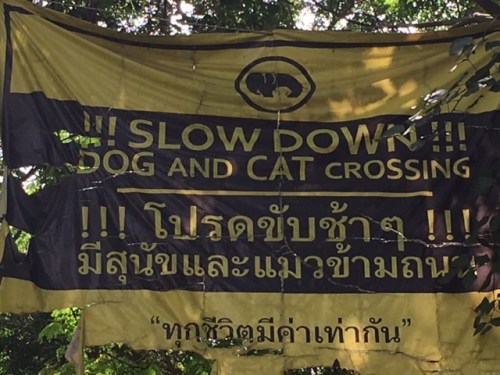
On 250 acres of land donated from a wealthy American family, ENP has grown to include 72 elephants, 500 rescue dogs, Cat Kingdom cat rescue, 50 water buffalo including Violet a baby water buffalo who was rescued and raised by people and considers herself human, birds, monkeys, wild boar, a single pig and I suspect many others I didn’t see.

We had no idea all these animals were being rescued here when we first arrived.  It feels like something much bigger and is a grand gesture of generosity towards all living things. It is the way Lek believes the world needs to work – the true way of moving forward on this planet together.

The vegan menu that is served three times a day during our stay, underpins this philosophy. Animals don’t need to get hurt to serve our needs. And the food is delicious by the way. I actually gained weight during our stay.

A quiet revolution can also be an economic driver

ENP is a bustling hive of activity. From the moment we arrived it felt like we were on a sanctuary swat team. There are minivans delivering people, trucks delivering food and goods, and a busy kitchen preparing food, beds to be cleaned, laundry, animals to be tended to, mahouts tending to elephants. Without having the daily receipts in front of me, I sense that this experiment in kindness is proving to be a successful business model.

Spreading the love
Elephant Haven.JPG

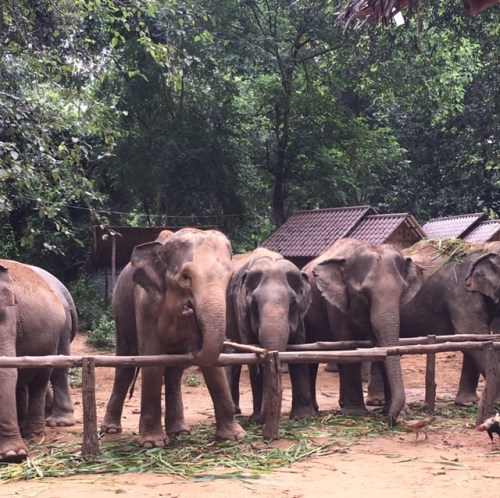
In addition to running ENP, Lek works with local trekking camps to change their business from riding elephants to being with elephants. In return they have access to her vets and she promotes them through ENP. To date 15 have moved towards non-riding eco models.

Elephant Haven

We weren’t done when we left ENP so we went back to the Save the Elephant Foundation office in Chiangmai (where we met many friendly dogs, including one naughty little pug who lovingly dined on my skirt) and asked Ms. Patty what next. She pointed us to the direction of Elephant Haven, quickly helped us make the plans and off we went.

We spent 4 days at Elephant Haven  in Kanchanaburi about 1.5 hours outside of Bangkok. With only 12 elephants I imagine it is closer to what ENP was just a few short years ago.

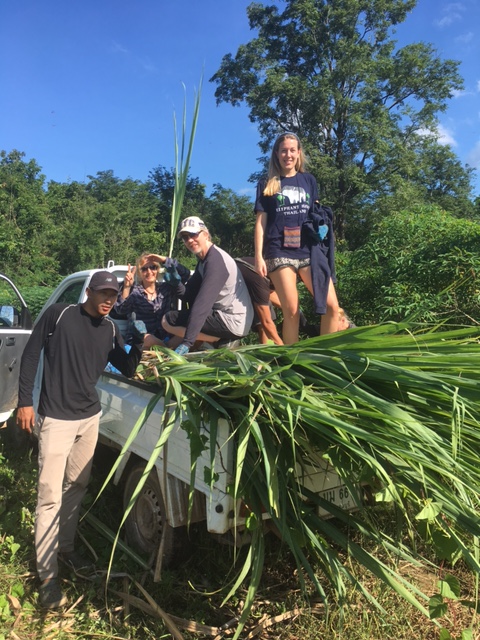
We woke up to elephants outside our cabin window and spent the days making elephant food, cutting sugar cane, and wandering in the woods with elephants  sometimes only a few  even inches away from us.
sugarcane

While it’s still many steps behind ENP it is encouraging to see and you can only hope that the word will grow like wildfire amongst tourists to support elephants in a more respectful and humane way.
Rambo.JPG

 The future of Asian elephants

Watching the elephants slowly amble their way through the landscape at ENP, stopping to scratch, moving with their families to fields in green pastures, I feel anxious for their future.

Asian elephants are an endangered species and part of the miasma of wildlife rapidly vanishing from our planet.

At the start of the 20th century there were 100,000 elephants in Thailand alone and today there are between 3,000 to 4,000 wild Asian elephants with a global population of fewer than 30,000. After the logging trade was closed in 1989 Thailand has a population of 2,700 domesticated elephants.

Conservationists also worry for the long-term outcome of these magnificent animals. The jungle, their natural home, is being taken away for land use. Population demands, deforestation and demand for ivory are their greatest threat.

As I walked with them in the jungle and watched them from afar, I marveled at how much these giant herbivores eat huge quantities of fruits and vegetables every day.

I witnessed first- hand their need to wander distances. I feel anxiety that these amazing creatures, these giants are meant for another world, another time.

But as I watch the hustle and bustle of trucks bringing in food, supplies, and the minivans bringing in hundreds of people every day, I feel a tiny ray of hope for the domesticated elephant anyway. This looks like economic development to me. Perhaps Thailand can become the leader in ethical tourism for one of its most revered and cherished symbols.

There’s a woman out there called Lek Chailert and she has built a sanctuary, a house of rescue, a revolutionary business model, a new way of helping elephants survive.

She has the magnificent heart of someone who does the tough work of rescue. Not just a part of it. All of it. I feel lifted by this thought and hope that I can be a small part of this revolution she is creating.

8 Comments

Filed under Animal Activism, Random Musing, Uncategorized

Canada Refuses an Ivory Ban Motion to Protect Endangered Elephants

Vancouver – Global March for Elephants and Rhinos Press Release

FOR IMMEDIATE RELEASE

Canada Refuses an Ivory Ban Motion to Protect Endangered Elephants

Prior to the Global March for Elephants and Rhinos

Vancouver Joins the Global March with a Mardi Gras for Elephants and Rhino

Vancouver, BC, September 15, 2016 – Canada was one of only four countries that objected to motion by the International Union for the Conservation of Nature (IUCN) last weekend. The motion called for every country to ban their internal trade of ivory and would help protect elephants facing extinction due to rampant poaching. The ban is enthusiastically supported by 145 cities participating in the Global March for Elephants and Rhinos on September 24. Well over 50,000 people are expected to march in 38 countries, to coincide with the first day of the Convention on International Trade in Endangered Species of Wild Fauna and Flora (CITES) conference

The feud between Canada, South Africa, Namibia and Japan, versus the other 213 government agencies at the World Conservation Congress, caused walkouts and threats of cancelled membership. Canada argued that the ivory ban would affect the hunting of walrus and narwhal by the Inuit in Canada’s Arctic. The two government agencies that abstained were the Canada Parks Agency and Canadian Museum of Nature.

An African elephant is killed every 15 minutes and a rhino is poached every 8 hours, sometimes enduring days of pain before death. There are fewer than 400,000 elephants and 18,000 rhinos left in the wild in Africa. At this rate, it is estimated that both species face extinction in the wild in as soon as 10 years.

While the IUCN motion is not legally binding, it is hoped that it will encourage a commitment to both an international and domestic ban of ivory trade at the upcoming conference in Johannesburg. John Scanlon, secretary-general of CITES has said the conference “is without doubt one of the most critical meetings of CITES in its 43-year history.”

Canada is a signatory to CITES but is yet to publicly state the level of protection it intends to afford elephants, when it votes at the conference. Given the significance of this year’s conference, the Global March for Elephants and Rhinos is poised to be the world’s largest demonstration to save animals. Vancouver, Edmonton, Saskatoon, Sudbury, London, Toronto, Montreal and Halifax will all take part.

Elephanatics, an elephant conservation non-profit group in Vancouver, is hosting the city’s third year of participation in the Global March with a Mardi Gras for Elephants and Rhinos. The family-friendly celebration of these iconic animals facing a tenuous future, is free to attend at Creekside Park beside Science World on Saturday, September 24 from 12pm – 2pm.

Activities will be free or by-donation and will cater to all ages. Attendees can also learn how easy it is to help save the few elephants and rhinos that remain. Live music, Mardi Gras necklaces, elephant mask-making, wildlife face painting, henna tattoos, a pro-animal graffiti wall, and an elephant costume competition (for humans and dogs!) will be available. A professional photographer will give guests a photo of themselves beside a 2-metre high elephant or rhino image. Elephanatics also promise the biggest “trunk sale” of pachyderm-themed jewelry, homewares and clothing. All donations benefit the Elephant Crisis Fund – an anti-poaching initiative from Save the Elephants and the Wildlife Conservation Network.

“Can you imagine your children not ever being able to see a live elephant in the wild? The Mardi Gras is a unique opportunity to tell Canada’s CITES delegates to stand with the rest of the world and stop the poaching. Canadians don’t want a world without elephants, but we have to speak up at this event or it might be too late. Elephants don’t forget – so let’s not forget elephants,” explained Fran Duthie, Co-Founder, Education Director and Volunteer at Elephanatics.

Patricia Sims, an award-winning documentary filmmaker (When Elephants Were Young) will explain how an ivory sale price in China of CAD$1,500 per kilogram attracts international terrorist groups like the Lord’s Resistance Army (LRA). Sims co-founded World Elephant Day (August 12). Now in its fifth year, the initiative partners with 100 elephant conservation organizations worldwide.

Film and television actor, Paul Blackthorne (“Quentin Lance” in Vancouver-filmed Arrow), will also be a guest speaker. “It is more important than ever to support awareness raising efforts which pressure governments to implement and enforce wildlife crime laws. We simply can’t be the generation responsible for the extinction of elephants and rhino,” says Blackthorne.

Also joining the speaker’s panel is NDP MLA Mike Farnworth who has tabled a private member’s bill (M-234) banning the sale of ivory and rhino horn. This bill closes a loophole that permits trade in ivory and rhino horn in British Columbia.

To tell CITES delegates to provide elephants with the highest level of protection, a petition can be signed at http://www.elephanatics.org/blog. To take part in history’s largest and most powerful global wildlife event, join the Mardi Gras for Elephants and Rhinos and demand an end to poaching on Saturday September 24 beside Science World.

About Elephanatics

Elephanatics is a non-profit organization founded in May 2013 in Vancouver. It is run exclusively by volunteers who aim to help the long-term survival of African and Asian elephants through conservation, education and action. Elephanatics first introduced Vancouver to the Global March for Elephants and Rhinos in October 2014 and has hosted the annual free event ever since. www.elephanatics.org

About Global March for Elephants and Rhinos

Global March for Elephants and Rhinos is a registered, non-profit organization in the United States. It is a grassroots, worldwide movement demanding an end to ivory and rhino horn trade. The first march was in 2013. www.march4elephantsandrhinos.org

For more information or to book media interviews –

Contact: Tessa Vanderkop

Director of Community Engagement

Elephanatics

elephanaticsinfo@gmail.com

604-789-8886

Leave a comment

Filed under Animal Activism, Uncategorized

Canadians Demand An End to the Ivory and Rhino Horn Trade


FOR IMMEDIATE RELEASE

Elephants and Rhinos: Going, Going… Gone

Vancouver Joins Global March for Elephants and Rhinos with a “Celebration of Life” Mardi Gras

Vancouver, BC, September __, 2016 – Vancouver-based Elephanatics, a local elephant conservation group, is hosting the third annual “Mardi Gras for Elephants and Rhinos: A Celebration of Life”. The family-friendly event on September 24 at Creekside Park beside Science World, raises awareness of the plight facing the world’s remaining elephants and rhinos.

An African elephant is killed every 15 minutes and a rhino is killed every 8 hours. At this rate of poaching, conservationists estimate they both face extinction in the wild within the next 10 to 20 years.

This year’s Global March for Elephants and Rhinos is poised to be the largest demonstration of its kind, with over 125 cities around the world holding events on September 24. This is the opening day of the Convention on International Trade in Endangered Species of Wild Fauna and Flora (CITES) meeting of member nations in Johannesburg, who will vote on the level of protection given to elephants, rhinos and other species facing extinction. Canada is a signatory to CITES and is yet to publicly state the position it will take at the meeting.

In Vancouver, the event will be a free admission “Mardi Gras for Elephants and Rhinos”. Guest speaker Patricia Sims, a Victoria-based award-winning documentary filmmaker (When Elephants Were Young) says, “The Global March for Elephants and Rhinos is a rallying call for people to support organizations that are working to stop the illegal poaching and trade of elephant ivory and other wildlife products; protect wild elephant habitat; and provide sanctuaries and alternative habitats for domestic elephants to live freely.”

Echoing these sentiments is Paul Blackthorne, British TV and film actor, and star of the popular, locally filmed TV series Arrow. Also a guest speaker at the Mardi Gras, he says, “The poaching crisis continues, with both elephants and rhinos heading toward extinction in ten years. This is why it’s more important than ever to support awareness raising efforts which pressure relevant governments to implement and enforce wildlife crime laws. Rhinos and elephants have been around for millions of years – we can’t be the generation responsible for their extinction. Come to the Mardi Gras on September 24 and help do your bit to save these beautiful creatures.”

Also joining the speaker’s panel is NDP MLA Mike Farnworth who has tabled a private member’s bill (M 234 – 2016) banning the sale of ivory and rhino horn. This bill closes a loophole that permits trade in ivory and rhino horn in British Columbia.

The “Mardi Gras for Elephants and Rhinos: A Celebration of Life” is for all ages and will include free and by-donation activities where animal lovers can:

  • enjoy live music from local musicians
  • get creative at the Mardi Gras Elephant Mask Craft Table
  • encourage the kids to high-five a walking elephant mascot
  • treat the family to an elephant or rhino face painting
  • write their own pro-elephant message on the Mardi Gras “Graffiti Wall”
  • have a photographer take their photo beside a two-metre-high elephant image

Where: Creekside Park, 1455 Quebec Street, Vancouver (beside Science World)

When: September 24th – 12:00 pm to 1:30 pm

Admission: Free

More Information: Please visit http://www.elephanatics.org

About the Speakers

Patricia Sims – Award-Winning Filmmaker & Co-Founder of World Elephant Day

World Elephant Day (August 12) was founded with the Elephant Reintroduction Foundation of Thailand, an initiative of HM Queen Sirikit of Thailand. Now in its fifth year of global awareness building, it has partnerships with 100 elephant conservation organizations worldwide.

Paul Blackthorne – English Actor for Film, Television and Radio

Over the past three years he has collaborated with conservation organizations to raise awareness about the elephant and rhino poaching crisis. He ran two successful t-shirt campaigns: “Keep Rhinos Horny” and “Poach Eggs Not Elephants”.

Mike Farnworth – NDP MLA for Port Coquitlam

Mike serves as Opposition Spokesperson for Justice (Public Safety and Solicitor General). He is adamantly fighting a loophole allowing illegal rhino horn to be mixed and sold with legal horn that can be proven to be obtained before 1975. He recently tabled a private member’s bill at the legislature to outlaw the sale of ivory and rhino horn.

About Elephanatics

Elephanatics was formed in May, 2013. It is an elephant advocacy organization based in Vancouver, British Columbia. Its mission is to help the long-term survival of African and Asian elephants by raising awareness and disseminating information regarding the enormous challenges and suffering that elephants face in Africa’s poaching crisis and in Asia’s tourist trade. Elephanatics hosts Vancouver’s participating in the Global March for Elephants and Rhinos – www.march4elephantsandrhinos.org.

#ENDS

For more information or to book media interviews

Contact: Tessa Vanderkop

Director of Community Engagement

Elephanatics

elephanaticsinfo@gmail.com

604-789-8886

Attached

Elephant Ivory Quick Facts

Elephant Ivory Quick Facts

  • Approximately 36,000 elephants are killed annually for their ivory. That is one elephant every 15 minutes.
  • Canada is in the top 20 countries responsible for 97% of trophy hunting.
  • Environment Canada is responsible to administer and enforce laws that prohibit or strictly limit the importation and sale of elephant products in Canada as set out in the Wild Animal and Plant Protection and Regulation of International and Interprovincial Trade Act (“WAPPRIITA”).
  • WAPPRIITA allows for extremely limited importation and sale of elephant products in Canada, however, loopholes in the laws have allowed black market traders and others to import and sell in Canada elephant products that are strictly prohibited by WAPPRIITA.
  • Terrorist organizations such as the Lord’s Resistance Army, a Ugandan rebel group, fund their criminal activities largely through the sale of elephant ivory.
  • The trafficking of protected wildlife has spiked in the past decade, leading to an annual worldwide trade worth between $10 billion and $30 billion US.
  • Ivory is one of the more commonly trafficked items, and each year 35,000 elephants are killed for their tusks.
  • When restricted items are discovered in Canada, they are confiscated by the Wildlife Enforcement Directorate. The directorate houses many of these pieces in a room in a secret location near Toronto. Most items are used either for educational purposes or destroyed.
  • CBC’s the fifth estate obtained exclusive access to this exhibit room, and provides a guided 360-degree tour of some of the most exotic items in the collection – www.cbc.ca/news/multimedia/an-exclusive-look-inside-a-secret-wildlife-crime-exhibit-room-1.3522808


Leave a comment

Filed under Animal Activism, Uncategorized

Lucy in Captivity – The Ethics of Moving Her — elephanatics

Lucy is one of the world’s most controversial elephants. She lives alone in Edmonton’s Valley Zoo. For year’s activists have tirelessly campaigned to have her moved to a sanctuary where she can live out her life in a warmer climate with other elephants. Elephants are known to be exceptionally emotionally intelligent and social animals. On […]

via Lucy in Captivity – The Ethics of Moving Her — elephanatics

Leave a comment

Filed under Animal Activism, Uncategorized

2016 Mardi Gras for Elephants and Rhinos: A celebration 4 life

12734243_10153776260215358_6944977851216971239_n.jpgAs some of you may know I work to raise awareness of the issues facing the world’s remaining Asian and African elephants. I am part of a group based in Vancouver called Elephanatics. We are a conservation group that does educational outreach, action and advocacy in Canada on behalf of elephants.

For the last two years we have organized a event in Vancouver that is part of a global, grassroots initiative called The Global March for Elephants and Rhinos. Last year over 140 cities organized worldwide. This year we hope to have even more cities participate. Our goal is put continued  pressure on governments and policy makers worldwide to end the ivory and rhino horn trade and to save many of Africa’s endangered species by moving them to Appendix 1 under the convention of the international trade in endangered wildlife and fauna known as CITES.

We are encouraging people in cities around the world to organize events large and small (last year two elderly women organized an event on their street corner which was completely inspiring!)

Without global action elephants and rhinos will be extinction with 10 to 25 years.

On September 24th events will be held worldwide for the opening day of CoP17 in Johannesburg.

Vital decisions on elephants, rhinos and lions are to be made at CoP17 by 181 members of CITES. Our objectives are to halt all trade and to get governments (who are CITES members) to change laws, have political will to stop the trade.

Last year over 50,000 people marched to raise awareness and to demand an end to the poaching crisis that is pushing them rapidly towards extinction.

The poaching of elephants and rhinos has reached unprecedented heights in recent years as the demand for ivory and rhino horn has soared in China and other mainly Asian markets.

An elephant is brutally killed every 15 minutes – 35,000 every year.

A rhino is poached every 11 hours with an estimated 24,000 left in the world. Over 1,000 rhinos were poached last year alone, compared to 13 in 2007.

Speakers at Vancouver’s events this year are:

Patricia Sims –  Co-Founder of the annual World Elephant Day, a global awareness campaign that brings attention to the critical threats facing elephants. The campaign reaches millions of individuals across the globe through events, traditional media, and social media outreach.
She produced, directed and wrote the documentary When Elephants Were Young,  narrated by William Shatner which won best documentary awards in both the Whistler Film Festival and Palm Springs FF..

Paul Blackthorne is an English Actor for film, television, and radio. He is currently a lead actor in the series “Arrow” which is filmed in Vancouver BC. Over the past three years he has collaborated with different conservation organizations to help raise awareness about the poaching crisis facing the African elephant and the rhino. He has run two successful t-shirt campaigns: One in Vietnam for the rhino with the slogan “Keep Rhinos Horny” and another for the elephant “Poach Eggs Not Elephants”.He is a committed social activist for wildlife conservation and has implemented a range of activities calling for joint global efforts to save wild animals, especially the elephant and rhino.

Mike Farnworth is the current NDP MLA for Port Coquitlam.
He serves as Opposition Spokesperson for Justice (Public Safety and Solicitor General).

Mike has been adamant in trying to fight a loophole in Canadian law that allows rhino horn to be sold if it can be proven to be obtained before 1975. Illegal horn is easily mixed with legal horn and thus forms a loophole. He recently tabled a private members bill at the legislature to outlaw the sale of ivory and rhino horn.
Join us on Twitter: @condofire @elephanaticsBC
Vancity_GlobalMarchElephants Instagram

Here is a short informational video about the ivory trade:
https://www.youtube.com/watch?v=HfooocokOr4&list=UULXXG0683FswkRlXk4CTjFQ

www.elephanatics.org

2 Comments

Filed under Animal Activism, Uncategorized

The Importance of an Ivory Burn

The Importance of an Ivory Burn

13062358_1258667860818029_4296988414452229999_n

Some people ask what the reasoning is behind an ivory burn. Some have suggested that flooding the market with ivory would help drive down prices and demand or that a one-time sale of this ivory could fund conservation efforts.

Discussion was further fuelled by Kenya’s recent ivory burn that took place in Nairobi National Park on April 28th, 2016. With eleven pyres of the tusks of roughly 8,000 elephants, as well as rhino horns and animal skins, this was the largest burn every to take place.

Many nations, including the US and Kenya have publicly destroyed ivory contraband to stop the trade. (Ivory Stockpile Burns 1989 – 2016)

Here are some reasons why the ivory burn was the right decision.

  • The ivory is illegal to sell as per CITES Appendix I and many nations’ laws;
  • Previous one-off sales of ivory have resulted in dramatic increases in poaching; and its sale would be morally reprehensible.
  • Countries who destroy ivory show that they value the whole elephant, that ivory belongs only on them, and it’s valuable ONLY to living elephants.
  • If Kenya’s 105-tonne ivory stockpile had legally entered the market, it would have provided a conduit for laundering the vast amounts of illegal ivory that are smuggled out of Africa and into Asian nations, funding terrorist groups like Boko Haram and al-Shabab.
  • History has shown us that after CITES listed the African elephant on Appendix I and banned the international trade in ivory in 1989, poaching levels dropped, elephant populations began to recover and flourish again, and the illegal trade slowed dramatically.
  • The two legal CITES one-off sales of ivory stockpiles, to Japan in 1997 and Japan and China in 2008, had disastrous consequences for African elephants.
  • China’s ivory carving factories fired up and the poaching crisis exploded.
  • More than 100,000 African elephants have been slaughtered in recent years, with approximately 90% of tusks successfully smuggled through transit nations and into the vast black market. The New York Times reported in 2012 that 70% of illegal ivory was being smuggled into China. Legal trade fuels poaching and increases demand for more ivory.
  • China’s population is 1.408 *billion* people. Even if only 1% of the Chinese people purchased ivory, that’s still 14 million people demanding it. With only about 450,000 elephants at most still existing on the African continent, the species would be wiped out with legal trade and an escalation in demand.
  • It’s estimated that only 10% of illegal tusks are intercepted and seized. Imagine how immense Kenya’s burning stockpile would have been if all illegal ivory had been recovered.

Elephant advocate Ann Early made the point about today’s ivory burn in the most succinct statement we’ve read, and kindly gave her permission to share it:

“All day I’ve been defending the Kenya ivory cremation in comments on articles or posts from people who think the tusks should be put on the market to raise money for Kenya. it is hard for some people to grasp the moral contradiction of selling the tusks of poached elephants into the ivory market while decrying the destruction and unspeakable torment of this species by that very same trade.”

Kenya did the right thing and we applaud the Kenya Wildlife Service for their hard work and vision, as well as Dr. Richard Leakey and Dr. Winnie Kiiru who supervised the operation and the verification of inventory. Thank you to all the elephant researchers and conservationists who attended the ivory burn; as heartrending as these images are for those of us a continent and ocean away, we can only imagine how sorrowful it must have been for you to witness in person with the acrid smell of smoke and death in the air.

Someday future generations who will inherit the earth will look back at these times and the ghastly crimes against elephants and nature, which are also crimes against humanity, particularly the African people. Robbing a nation’s people of their wildlife – which provides tourism jobs and accounts for 12% of Kenya’s GDP – and killing the creatures who grow the forests and are intrinsic parts of their ecosystems is a crime against the nation’s people.

Humanity should collectively hang our heads in shame for the elephants’ unfathomable suffering and tortuous deaths. It’s a stain on our species that legal trade in ivory was ever allowed and that we have not yet stopped the poaching. It is our imperative to do so.

This is our last chance to save elephants from extinction. We don’t get a do-over once they’re gone, and if we allow elephants and rhinos to go extinct, it would be humanity’s unpardonable crime.

Photo credits:

First photo: Stand Up Shout Out

Text adopted from : ‪#‎GMFER core strategist Lori Sirianni, on behalf of the Global March for Elephants and Rhinos

Leave a comment

Filed under Animal Activism

Fashion Week Shines a Spotlight on the Elephant Crisis


Vancouver, BC: In an industry that regularly garners criticism from animal advocates, Vancouver Fashion Week (VFW) is showing the world that animals do in fact matter. On Saturday (March 19) March 20 (VFW ) will feature Elephantasia, a pachyderm-inspired, eco-couture collection by a collaboration of 12 different designers globally. This travelling exhibition will raise awareness and funds for African elephants who are killed for their ivory. In Africa an elephant dies every 15 minutes. Ninety-six elephants die from poaching per day and at this rate, African elephants will be extinct within our generation.

Elephantasia is enlisting the support of BC’s only elephant advocacy organization – Elephanatics. Based in Vancouver, the group helps the long-term survival of elephants by raising awareness, organizing events such as the Global March for Elephants and Rhinos, and providing education on the enormous challenges elephants face in Africa’s poaching crisis and in Asia’s tourist trade.

The fashion show On Saturday March 19th will also include guest speaker, Dr. Jake Wall, Chief Scientific Research Advisor for Elephanatics. (Elephanatics, Save the Elephants, UBC Grad and National Geographic Explorer) He will speak at 4:30 pm about the current poaching crisis in Africa. Dr. Wall developed a real-time monitoring system using high-tech GPS tracking technology inside collars that were put on wild elephants. The system helps counter elephant poaching in Kenya and South Africa. Dr. Walls technology was instrumental in capturing iconic footage of a one-hundred-plus elephant herd for National Geographic’s documentary, Great Migrations.

On Sunday (March 20), Elephanatics will host an information booth at VFWs show at the Chinese Cultural Centre at – 4:00 pm. The booth will be collecting donations for the African Wildlife Foundation and encouraging donations with the David Sheldrick Wildlife Trust’s baby elephant orphanage in Kenya that cares for the young elephants orphaned by poaching, until they are ready to be introduced to the wild again.

EVENT DETAILS

Elephantasia at Vancouver Fashion Week

March 19 14 to 20, 2016 at 4:30 pm

Chinese Cultural Centre of Greater Vancouver

50 East Pender Street

Vancouver, BC

http://vanfashionweek.com/elephanatics/

FOLLOW THE CAMPAIGN

http://www.elephanatics.org

Twitter: @elephanaticsbc

facebook.com/Elephanatics/

Instagram: Elephantasia2016

MEDIA CONTACT

Tessa Vanderkop

elephanaticsinfo@gmail.com

604-789-8886


Leave a comment

Filed under Animal Activism, Uncategorized

Gito and Asoka Meet for the First Time

I have fallen in love with orangutans. The  International Animal Rescue first brought young Gito to my attention with a horrific picture of an almost dead baby organgutan who had been left to die in a box. He could barely move, was undernourished and suffered from severe mange. Not only are orang-utans threatened because their home in Indonesia is being deforested and sold to big companies to grow palm oil (products we buy and support) but they are also captured and traded as pets. This puts orang-utans on the path of extinction.

Anyways, I fell in love with Gito and wanted to learn a bit more. Videos are posted regularly of Gito and other rescues progress as the make their way through their new lives.

In this video, Gito meets Asoka for the first time. Since his capture from his family he has not seen another organgutan. This video is truly touching.  If you want to help, please share and start to tell the stories of these animals. It’s the only way organizations like The International Animal Rescue can get support for their work and people around the world can find out what is happening to one of the world’s most iconic and truly wonderful species.

My Christmas present this year was Gito. My husband adopted him for me. He is now on my list to go and visit.


Leave a comment

Filed under Animal Activism, Orangutans

2015 A Year in Highlights for Elephants

Hi everyone,

As 2015 has drawn to a close we wanted to take a look at some of the victories for elephants around the world. While elephants continue to face numerous challenges there are some things to celebrate.  Let’s take a look:

Poaching

US China Deal to Ban Ivory Trade is Good News for Elephants  Read more here.

New York, New Jersey, and California all have passed laws banning the sale of ivory, with fifteen other states expected to introduce similar legislation in the coming years. Read more here  and here.

Obama proposes sweeping ban on U.S. Ivory Sales Read more here.

California passed AB96, banning the sale of ivory and rhino horn.

Voters in Washington state sent a strong message to the world on November 3 when they passed the country’s first ever comprehensive state ban on commerce in endangered animal species. Read more here.

Tanzania Confident it Can Eradicate Poaching Within 4 Years. Read more here.

A woman dubbed the ‘ivory kingpin’ for her alleged leadership of one of Africa’s biggest ivory smuggling operations has been charged. Read more here.

Namibia’s elephant population grew by more than 70% between 2002 and 2013 from 9,600 to 16,000. Across Northern Kenya there has been a 43% decline in elephant poaching between 2012 and 2014. Read more here.

Community led approach to elephant conservation has a positive impact. Read more here.

Elephants in Circuses

Richmond, VA and Austin, TX banned the use of the bullhook. effectively making it impossible for circuses to force elephants to perform within city limits. Read more here.

Holland bans the use of wildlife from performing in circuses. Read more here.

Trophy Hunting Expo was shut down in Orlando Florida and in Toronto, Ontario

Last but not least over 130 cities all around the world marched for elephants in 2015 – with over 3,000 attending the march in Nairobi and approximately 40,000 people marching worldwide. Read more here.

Elephant Nature Park, Wildlife SOS both continue to do amazing work through education and awareness and the rescue of  elephants and other animals in distress.

This list is by no means complete and is intended simply as a highlight. If we’ve missed something, drop us a line and we’ll add it.

Together we’re making a difference. Let’s keep doing it.

Visit elephanatics.org

This is a repost from here.


Leave a comment

Filed under Animal Activism, Uncategorized

Elephants have families too: film short by Hugo Guiness

‪#‎RememerberMe‬ Watch this beautiful short film by Hugo Guiness + please share! ‪#‎DSWT‬ ❤

Leave a comment

Filed under Animal Activism