By Alison McGhee, a pre-amble to the poem “For Nothing is Fixed” by James Baldwin
Last week, late at night, the fire alarm in my cheap motel began to shriek. Doors opened up and down the hall and men began to emerge: huge men, small men, men in their underwear, one on crutches, one pushing a walker, one carrying a case of beer, one sweating as if just out of a sauna. This is the strangest assortment of men I’ve ever seen, I murmured to myself. One of the men leered or smiled, hard to tell.
Next morning in the breakfast room I sat tapping on my laptop while the hallway men shuffled in one by one. The leer/smile man sat next to me. I could tell he wanted to talk but I pretended to be too absorbed in my work to look up. This did not stop him.
“Hey! I like your pink hair! How’s it goin’?”
It was early. There were six hundred miles ahead of me. I didn’t want to talk. But then the last lines of this poem by James Baldwin came to me and I closed my laptop and turned to him and smiled. Had a long conversation about the fire alarm, the slim pickings at the breakfast buffet, his favorite smoking rituals back when everybody smoked, hard to believe it now, right?
He was a lonely man. He just wanted to talk. Sometimes it feels like most people are lonely, and most people just want to talk.
For Nothing Is Fixed, by James Baldwin
For nothing is fixed, forever, forever, forever, it is not fixed; the earth is always shifting, the light is always changing, the sea does not cease to grind down rock. Generations do not cease to be born, and we are responsible to them because we are the only witnesses they have. The sea rises, the light fails, lovers cling to each other, and children cling to us. The moment we cease to hold each other, the moment we break faith with one another, the sea engulfs us and the light goes out.
Many Canadians assume that Canada is a leader in areas such as conservation. It is surprising for many to learn that this is simply not the case. In fact, not only is Canada not a leader, it is, as laggard. As countries including the UK, China, several states in the US, France, the Netherlands, Taiwan, Singapore, Hong Kong, Australia, Belgium and Israel have either closed or are preparing to close their domestic elephant ivory trade, Canada fights to keep it open. Below is Canada’s voting record at CITES, the Conference of the Parties to the Convention on International Trade in Endangered Species of Wild Flora and Fauna (CITES CoP18)
Elephanatics, World Elephant Day and Global March for Elephants & Rhinos – Toronto have been in contact with Minister McKenna’s office several times to ask why Canada, in spite of calls by CITES for all markets to close their domestic ivory trade, still hasn’t done so and in fact does nothing to support increased protection for elephants. Why is Canada an outlier when it comes to the protection of the world’s most iconic, keystone species?
There were five proposals for the regulation of elephant trade. This is how Minister Catherine McKenna’s deputies voted on these proposals at the conference.
Proposal 44.2 – A near-total ban on removing baby African elephants listed in Appendix II from the wild and selling them to zoos around the world was approved.
Canada voted NO to protecting wild baby elephants from export.
Proposal 10 – Zambia proposed to down-list its elephant population from Appendix I to II, thus paving the way to allow commercial trade in ivory. It failed to pass.
Canada voted YES to decreasing the protection for Zambia’s elephants.
A proposal to tighten protection for elephants by permanently eliminating all commercial international trade of the animals throughout Africa failed to pass.
Canada voted NO to tightening the protection for elephants.
Proposal 12 – Gabon and other countries proposed to up-list all African elephants to Appendix I, thereby affording them the greatest level of protection. It did not pass.
Canada voted NO to affording greater protection for elephants.
Proposal11 – South Africa, Botswana, Namibia, and Zimbabwe brought forward the controversial proposal to re-open their ivory trade. It was voted down by 101 of the 183 treaty members.
Canada’s vote was non-registered.
There was also a proposal to increase the hunting trophy quota for the endangered black rhino in South Africa. Canada voted in favour of increasing the number of black rhinos that could be killed for trophies in South Africa.
The Ivory-Free Canada petition is asking the government to close the domestic elephant ivory trade in Canada has garnered close to 500,000 signatures. It is clear Canadians don’t have an appetite for being complicit in the demise of one of the world’s most emotionally intelligent and sentient species. If you haven’t already., please sign the petition and write your MP expressing your concern.
This is a question I have been asked many times over the past 7 years since founding Elephanatics, an elephant advocacy organization in Vancouver, B.C. Elephanatics recently formed a coalition of organizations to include the Jane Goodall Institute of Canada, Humane Society International-Canada, Global March for Elephants and Rhinos – Toronto, and World Elephant Day. […]
I couldn’t put it down from the moment I read the first page. The story of a missing anybody is always compelling. What happened to them? Why did they leave? Are they dead or alive? What led to their disappearance? And who is left behind to wonder?
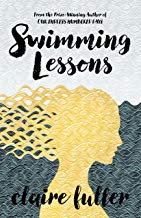
Swimming Lessons is the story of Flora Coleman, a young woman whose mother disappears when she’s eleven. It’s also the story of her mother Ingrid Coleman, as told through letters she has written and hidden in books throughout their house to her famous husband, the writer, Gil Coleman.
Flora returns to her childhood ramshackle seaside home to help care for her ailing father who believes he has seen Ingrid. Flora, herself doesn’t believe her mother is dead and often sees her. You’re never sure whether this is real longing for a mother who simply disappears but is assumed drowned or if in fact, Ingrid, whose life had become isolated and unbearable disappeared herself.
Just as there are no certainties in life, the reader too must decide in the end what happened to Ingrid Coleman.
What makes this book so compelling is the contents of the letters Ingrid writes to Gil, each one revealing to him what she could never say during the course of their tumultuous marriage. In Ingrid’s last letter she instructs Gil on how to care for their two young children. Is it a suicide note or a goodbye of another kind?
That she has reason to leave him is clear. When they first meet in the sixties in London, he is her handsome, flamboyant English instructor almost twenty years her senior, and she is a twenty year old student from Norway. Everything from the very beginning screams, run away, choose life number two and stay free, as her friend Louise warns her but she falls deeply in love and becomes pregnant. And the rest is history. She can’t escape the reality of her life as a somewhat reluctant mother, a husband who is emotionally and physically absent and the numerous heartbreaks along the way. That she lasted as long as she did seems a miracle but the letters describing the heady romance of their early days seems deep enough to last a lifetime and this love, in spite of everything, keeps her hanging on. If only he had loved her as she had loved him. And when she does think of leaving, the reality of being a young woman with no education stop her at the front door. How could she manage?
In the end Flora, her youngest daughter has to decide if she can let her mother live or if she has to put her to rest. It’s how we square the circle and find peace in the end and each one including Gil finds it their own way.
I loved this book. It was beautifully written, giving the reader an incredible sense of place and time and a snapshot of a young woman who’s heart was broken by love.
Thanks to the amazing Jane Goodall for her op-ed in today’s Globe and Mail in honour of World Elephant Day. Please sign our petition or write your MP to end the legal trade of ivory in Canada today.
OPINION
Why hasn’t Canada banned the elephant ivory trade?
My fascination with and love for elephants began when I first encountered a herd. I was on foot in the forests on the rim of Ngorongoro Crater, and I was able to spend time with these magnificent beings in Tanzania’s Ruaha National Park. I was there with my late husband, Derek Bryceson, who was the director of Tanzania National Parks at the time. We had arranged training workshops for park rangers who would follow individuals and record their activities using techniques similar to those we developed in Gombe to monitor chimpanzee behaviour.
Although I could not be there often, I got to know a number of elephants individually. There was Fred, a juvenile male. He was a real show-off and would chase almost anything – antelopes, warthogs, cattle egrets – trumpeting fiercely, ears spread. I even saw him charge a butterfly.
One individual I especially loved was a very old male, Ahmed. His ears drooped and his skin was loose, hanging in folds around his ankles. He moved slowly and deliberately and often stood in the shade by himself, his trunk draped over one of his tusks.
Elephants are highly intelligent. During dry periods, the older members of the herd remember the locations of water holes they visited years before. They form strong social bonds and have emotions similar to our own. If danger threatens, the adults will circle the mothers and calves protectively and are ready to charge. They care for adults of the herd as well: One researcher observed three male elephants attempt to revive a dying matriarch, lifting her body with their tusks as they tried in vain to get her back on her feet.
On World Elephant Day, we pay tribute to these wise, gentle giants who so perfectly represent the natural wonders of the world.
But today is not a time for celebration. This magnificent species, which once roamed across Africa in great herds, has been pushed toward extinction. In 1930, as many as 10 million elephants inhabited the continent. Today, there are only some 400,000 left. This decrease is almost entirely the ugly result of poaching, which is backed by criminal cartels to satisfy the demand for ivory. How shameful that human greed threatens these majestic, intelligent beings, slaughtering them for their tusks.
If we are to save this species, the demand for ivory – and other elephant parts – must end. In 2016, at the most recent conference hosted by the International Union for Conservation of Nature, the African Elephant Coalition (which comprises 29 countries representing the overwhelming majority of range states in which African elephants are found) called on countries around the world to close their markets for commercial trade in raw and worked ivory. The proposal was supported through a unanimous resolution.
Canada – along with Japan, Namibia and South Africa – has refused to do so. Unlike China, once the largest single market for the buying and selling of legal and illegal ivory, Canada continues to sanction a domestic marketplace for elephant ivory.
As a policy, Ottawa has banned sales of ivory from elephants killed post-1990. But because ivory is extremely difficult to date, illegally harvested supplies enter the Canadian market with little or no difficulty. (Canada has also expressed concern that banning elephant ivory could affect the well-regulated Inuit trade in worked narwhal and walrus ivory, although no evidence has been cited to support this claim.)
STORY CONTINUES BELOW ADVERTISEMENT
Canada also permits the importation of elephant trophies. Between 2007 and 2016, Canada allowed the legal importation of more than 400 elephant skulls and 260 elephant feet, according to the Convention on International Trade in Endangered Species of Wild Fauna and Flora, which tracks the movement of animals and animal parts.
Hunting causes terrible suffering to thousands of individual elephants. Moreover, profits from poaching fund criminal cartels, destabilize communities and feed corruption. Park rangers, on the front lines of protecting all wildlife, also pay a high price: In 2018, at least 63 African game rangers died in the line of duty, often leaving their families without support. And a number of people working to bring the ivory barons to justice have been brutally murdered.
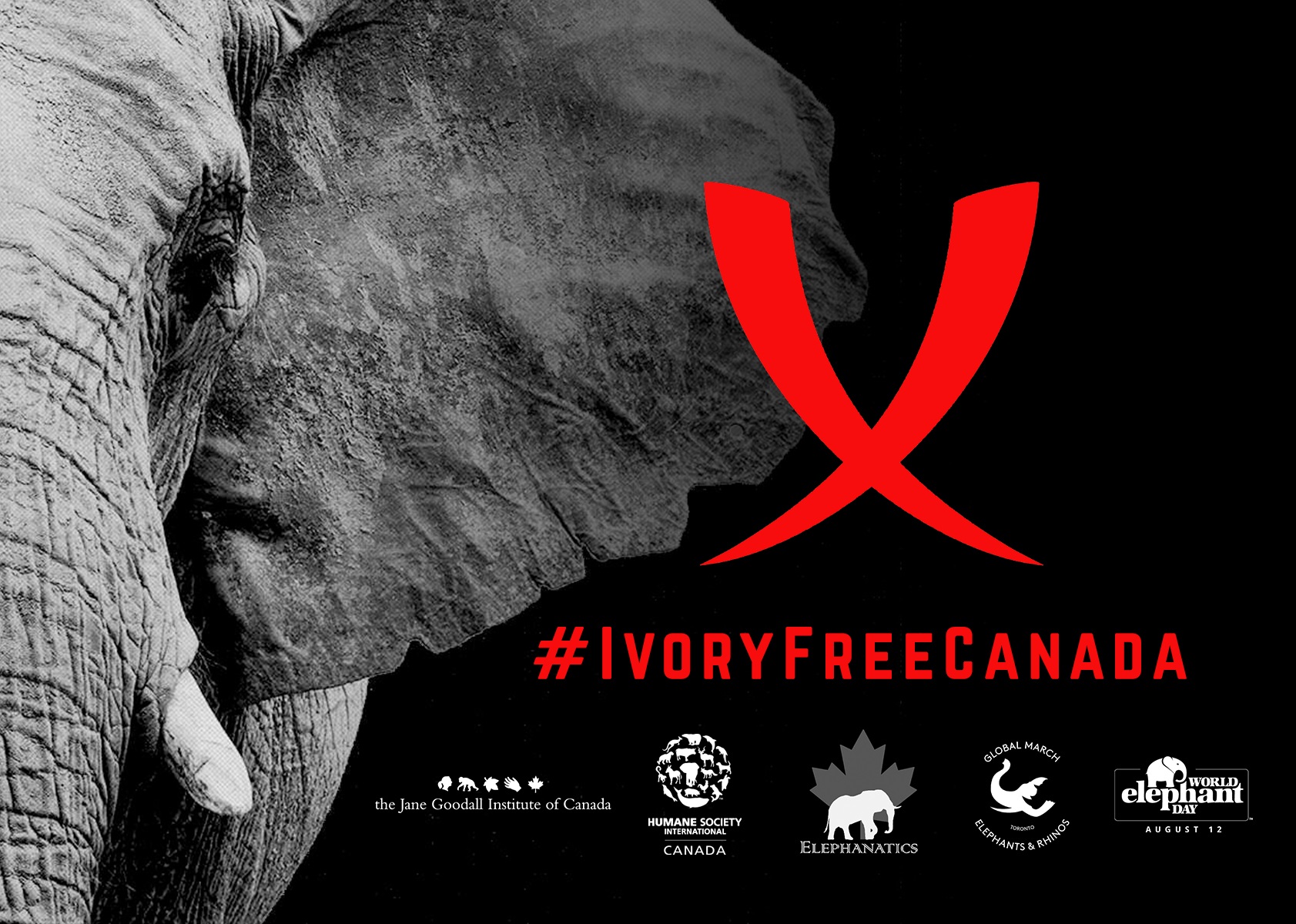
On World Elephant Day, the Ivory-Free Canada coalition, of which the Jane Goodall Institute of Canada is a member, is calling on Canada to ban the trade in elephant ivory. With its partners, – Elephanatics, Humane Society International-Canada, World Elephant Day and Global March for Elephants and Rhinos-Toronto – the coalition is asking Canada to join other responsible countries in the fight to save these iconic animals from extinction.
When I see elephant tusks or elephant ivory trinkets, I see the suffering and brutal death of the individual to whom they once belonged and the terror and heartache of the others in the herd.
But together we can change this. I choose elephants, not ivory. I choose an Ivory-Free Canada.
More than 400,000 have signed the petition asking for end to the legal trade in elephant ivory.
Help us get to 500,000 by World Elephant Day on August 12! www.change.org/IvoryFreeCanada
The ongoing slaughter of African elephants for their tusks has
decimated elephant populations. Today, this magnificent animal is highly
endangered and on the brink of extinction. Since 1980, the number of
elephants in Africa has fallen from 1.3 million to just over 400,000.
Currently an estimated 20,000 elephants are killed every year for their
ivory. At this rate, they will be erased from the wild in our lifetime.
Countries that have banned the domestic sale of elephant ivory within
their borders, or are in the process of doing so, include China, the
UK, France, the Netherlands, Hong Kong, Singapore, Taiwan, Belgium,
Luxembourg, the European Union and nearly every state in the United
States.
To date, the Canadian government refuses to do the same and also ban
the ivory trade. Shockingly, Canada is directly contributing to the
destruction of one of the one of the planet’s most iconic species by
keeping its elephant ivory market open for business.
Canada also legally permits elephant trophies to be imported. Between
2007 and 2016, Canada allowed the importation of 83 trophy elephants,
434 elephant skulls and 260 elephant feet.
Please join the Ivory-Free Canada campaign #IvoryFreeCanada and tell our government to end the legal domestic trade of elephant ivory.
Here’s how you can help save elephants:
1. Sign and share our petition!
More than 400,000 have signed already – thank you! If you haven’t added
your name yet, please help us get to 500,000 signatures by World
Elephant Day on August 12.
2. Trumpet the issue on social media! Watch for us on Facebook, Twitter and Instagram and share using #IvoryFreeCanada.
Our coalition is led by Elephanatics with supporting partners Humane Society International-Canada, the Jane Goodall Institute of Canada, World Elephant Day and Global March for Elephants – Toronto.
I feel as if we opened a book about great ocean voyages and found ourselves on a great ocean voyage: sailing through December, around the horn of Christmas and into the January Sea, and sailing on and on
in a novel without a moral but one in which all the characters who died in the middle chapters make the sunsets near the book’s end more beautiful.
And someone is spreading a map upon a table, and someone is hanging a lantern from the stern, and someone else says, “I’m only sorry that I forgot my blue parka; It’s turning cold.”
Sunset like a burning wagon train Sunrise like a dish of cantaloupe Clouds like two armies clashing in the sky; Icebergs and tropical storms, That’s the kind of thing that happens on our ocean voyage —
And in one of the chapters I was blinded by love And in another, anger made us sick like swallowed glass & I lay in my bunk and slept for so long, I forgot about the ocean, Which all the time was going by, right there, outside my cabin window.
And the sides of the ship were green as money, and the water made a sound like memory when we sailed.
Then it was summer. Under the constellation of the swan, under the constellation of the horse.
At night we consoled ourselves By discussing the meaning of homesickness. But there was no home to go home to. There was no getting around the ocean. We had to go on finding out the story by pushing into it — The sea was no longer a metaphor. The book was no longer a book. That was the plot. That was our marvelous punishment.
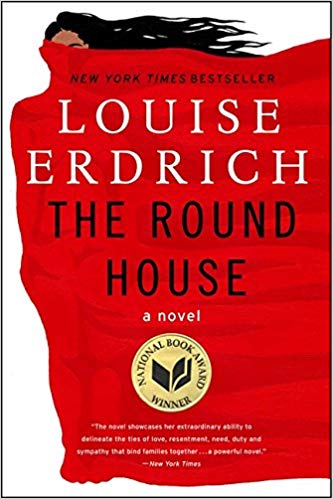
The Round House by Louise Erdrich is a treasure of a read. I grew up in Ontario but have lived most of my adult life in British Columbia. We were never taught indigenous, First Nation or Inuit history in lower and high school and although I went on to study history, I focused on Middle Eastern and American studies. Today, of course, I am much more aware of the sad history of my country and its first people and the more I learn the more horrified I am at the continued injustices that permeate our governance structure.
The Round House is a coming of age story that is told from the perspective of 13 year Joe Coutts, who grows up on an Ojibwe reservation in North Dakota. Set in 1988, the novel offers a glimpse of a young boy on the cusp of manhood, who over the course of a few months, avenges the horrifying rape of his mother. The tragedy drives the action in the novel but in many ways is a backdrop to the delightful cast of characters who live on the reserve with Joe including his close circle of friends Cappy, Zack and Angus. Joe’s father, Bazil is a judge and after the assault begins to share details of other criminal cases with his son. Joe and his friends become embroiled in solving the crime and in so doing, come to an understanding that the complex legal system and land issues could let the perpetrator go free.
While the story is dark, it is a beautiful evocation of the complexities that have resulted from stealing indigenous land and creating reserves. It’s a coming of age story that is oddly funny, incredibly tragic with writing that captures the beauty of people at one with the natural world and the characters that fuel generational mythology. So happy I found this book and want to thank my book fairy Cynthia for pressing this into my hands and saying “Read it. Read it.”
You are hometown. You are all my favorite places the last summer I grew up. Every once in a while I write you in my head to ask how Vietnam and a big name college came between us. We tried to stay in touch through the long distance, the hum and fleck of phone calls.
It was inevitable that I should return to the small prairie town and find you pumping gas, driving a truck, measuring lumber, and we’d exchange weather talk, never able to break through words and time to say simply: “Are you as happy as I wanted you to be?”
And still I am stirred by musky cigarette smoke on a man’s brown suede jacket. Never having admitted the tenderness of your hands, I feel them now through my skin. Parking on breezy nights, in cars, floating passageways, we are tongue and tongue like warm cucumbers. I would walk backwards along far country roads through late evenings cool as moving water, heavy as red beer, to climb into that August.
In the dark lovers’ lanes you touched my face and found me here.
For more information on Margaret Hasse, please click here.





 Condofire